
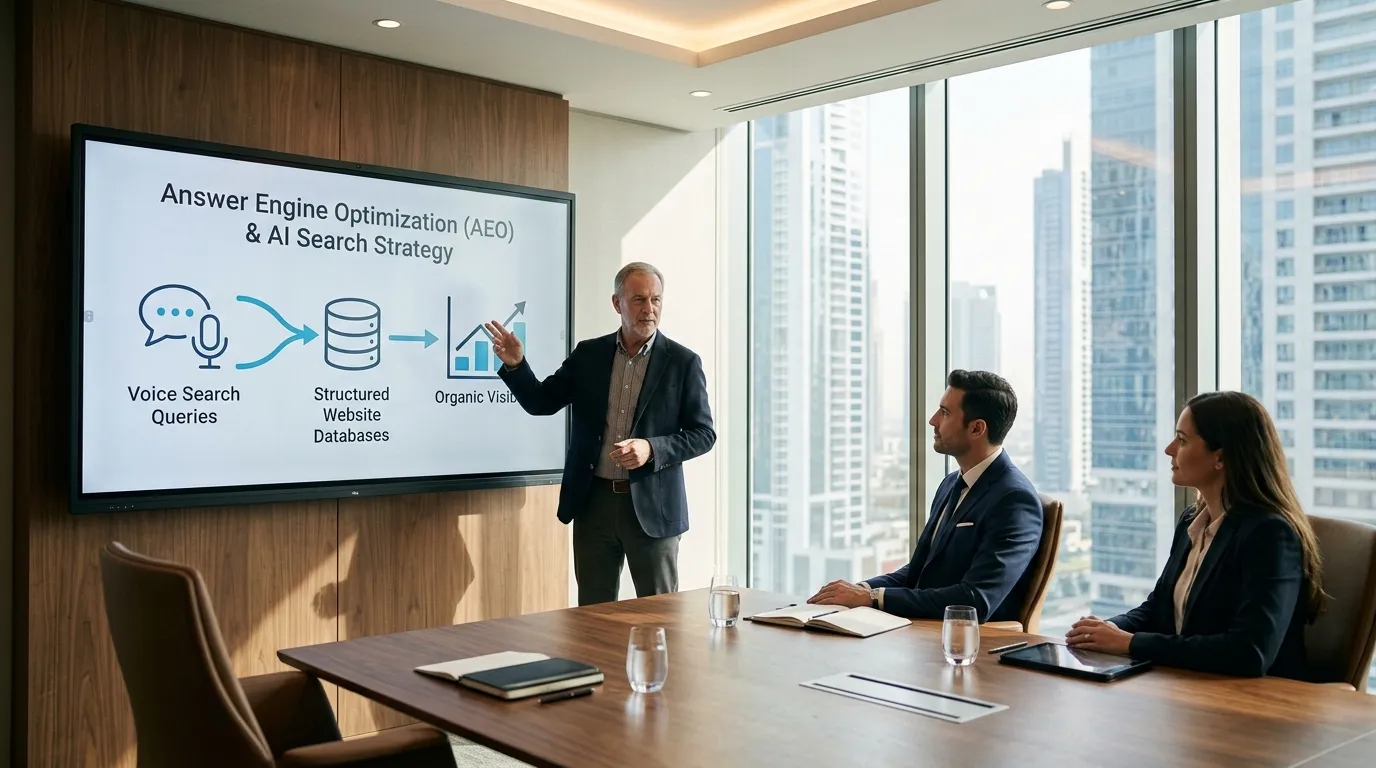
Beyond Traditional Search: How to Optimize Your Business Website for AI Search and Voice Queries (AEO/GEO)
The way potential clients find products, services, and local businesses has undergone a permanent shift. For decades, search engine optimization (SEO) focused entirely on ranking ten blue links on a traditional search results page. In 2026, buyers rarely scroll through pages of links. Instead, they ask conversational AI engines, voice assistants, and generative search models direct, complex questions like: "Which corporate legal firm near me handles cross-border contracts?" or "Book the best high-end dental clinic with weekend availability."
When an AI engine answers, it does not present a list of competitors—it synthesizes information and provides a single, definitive recommendation. If your website is not engineered for Answer Engine Optimization (AEO) and Generative Engine Optimization (GEO), your business simply does not exist in these curated answers.
Understand the Shift: SEO vs. AEO vs. GEO
Traditional SEO focuses on keywords, backlinks, and search volume to capture clicks. While traditional SEO remains foundational, modern AI models prioritize semantic relevance, contextual credibility, and clear data structure.
Answer Engine Optimization (AEO): Designing content so search bots and virtual assistants can instantly extract precise, direct answers for voice search and featured snippets.
Generative Engine Optimization (GEO): Structuring your website's authority, factual citations, and technical data so generative AI models cite and recommend your brand when generating answers.
Winning in this new search paradigm requires shifting from keyword stuffing to authority engineering.
Structure Content for Direct, Conversational Answers
Voice searches and AI queries are natural and conversational. Users speak to devices the way they talk to colleagues, using full sentences and specific constraints rather than fragmented keywords.
To make your content easily digestible for AI models:
Use Question-Based Headings: Organize sections around exact queries your ideal clients ask, using headers like "How much does a custom booking app cost?" or "What permits are needed for commercial renovation?"
Lead With the Direct Answer: Place a concise, 40- to 60-word definitive answer immediately beneath each heading before expanding into technical nuances. AI models extract these concise summaries directly into voice responses.
Implement Logical Bullet Points and Tables: AI synthesis engines favor structured data formats such as comparative tables, sequential checklists, and clear bullet points because they reduce extraction ambiguity.
Implement Comprehensive Schema Markup
AI crawlers do not read websites like human visitors; they parse underlying code to verify who you are, what you offer, and why you are trustworthy. Structured data (Schema.org) acts as a universal translation layer for AI models.
Critical schema types your website must include:
Organization & LocalBusiness Schema: Confirms your legal business entity, physical address, verified contact points, and operating regions.
Service & Product Schema: Defines specific offerings, deliverables, and transparent pricing structures.
FAQPage & HowTo Schema: Explicitly tags questions and answers, enabling search algorithms to feed your content straight into AI answer snippets.
Author & Person Schema: Establishes the real-world credentials and expertise behind your technical content.
Without structured schema, AI models must guess your operational details, and when an AI engine is uncertain, it defaults to a competitor with verifiable data.
Prioritize Lightning-Fast Technical Performance
Speed is a non-negotiable ranking factor for both traditional crawlers and real-time AI retrieval pipelines. Conversational models need to parse and retrieve data within milliseconds to deliver immediate answers to voice queries.
A technically optimized platform requires:
Sub-second mobile page load speeds and optimal Core Web Vitals.
Clean, semantic HTML5 code free from redundant scripts or heavy plugins.
Secure, encrypted HTTPS connections with verified SSL certificates.
Server-side rendering (SSR) to ensure automated crawlers instantly read fully rendered text without relying on heavy client-side JavaScript execution.
Build High-Authority Entity Citations
Generative AI engines rely on cross-platform verification to determine whether your business is reputable. An AI model will not recommend a company that only exists inside its own self-published blog.
To establish entity-level authority:
Maintain identical Name, Address, and Phone (NAP) details across business directories, Google Business Profiles, and industry registries.
Earn brand mentions and verified citations across third-party industry journals, partner platforms, and verified directories.
Highlight verifiable case studies, verified client feedback, and transparent credentials across your primary domain.
How Nexever Future-Proofs Your Digital Footprint
Navigating the technical requirements of modern AI search requires a unified digital ecosystem, not disconnected plugins or outdated templates.
At Nexever Digital Technologies, we develop custom, high-speed websites and applications engineered from the code up for AEO and GEO. Our managed growth platform includes:
Custom web architecture built for ultra-fast mobile indexing and zero bloat.
Comprehensive technical schema integration tailored to your specific industry.
Conversion-focused content structures built for voice search retrieval.
Free high-speed cloud hosting, custom domain configuration, and enterprise-grade SSL protection.
Continuous technical updates and performance maintenance.
Plans start from AED 349/month. Transition your business from passive web visibility to active AI-driven market leadership.
Connect with Nexever Digital Technologies today to prepare your business platform for the next era of search.
📧 hello@nexever.ae